


Simplifying XGS-PON deployments for Broadband Service Providers with Vecima’s vPON Manager
By: Vijay Raman, Vice President, Product Management
November 19, 2025

As the demand for broadband continues to grow, service providers are under pressure to deliver faster, more reliable, and more scalable connectivity. XGS-PON (10-gigabit-capable symmetrical passive optical network) technology has emerged as the foundation of next-generation fiber networks, enabling symmetrical 10Gbps services capable of meeting the needs of today’s data-driven homes and businesses.
Yet, deploying and managing XGS-PON networks at scale can be complex. From provisioning and fault management to device onboarding and observability, broadband service providers (BSPs) need solutions that simplify these workflows while maintaining reliability and performance.
That’s where Vecima’s Entra vPON Manager comes in. Purpose-built for modern PON environments, it brings powerful automation, visibility, and control to XGS-PON deployments.
What Is XGS-PON & Why Does It Matter?
XGS-PON represents the next major evolution in fiber access technology, building upon earlier standards that include GPON (gigabit passive optical network) and XG-PON (10G passive optical network). Here’s how it compares:
| Standard | Max. Downstream Speed | Max. Upstream Speed | Symmetrical? |
| GPON | 2.5 Gbps | 1.25 Gbps | No |
| XG-PON | 10 Gbps | 2.5 Gbps | No |
| XGS-PON | 10 Gbps | 10 Gbps | Yes |
With symmetrical 10 Gbps bandwidth, XGS-PON supports high-demand use cases such as multi-gigabit residential internet, enterprise services, 5G backhaul, and smart city infrastructure. It enables BSPs to scale bandwidth efficiently and deliver a superior user experience, all while leveraging existing fiber assets.
However, while the technology itself opens the door for new opportunities, deploying and managing XGS-PON networks introduces complexity in areas like configuration, device onboarding, and multi-vendor interoperability. BSPs need management tools that make XGS-PON accessible, not intimidating.
Common Challenges of XGS-PON Deployment
While XGS-PON offers performance and scalability advantages, deploying and operating these networks across large footprints can present several challenges for broadband providers. These include:
Simplifying XGS-PON Deployments With Vecima’s vPON Manager
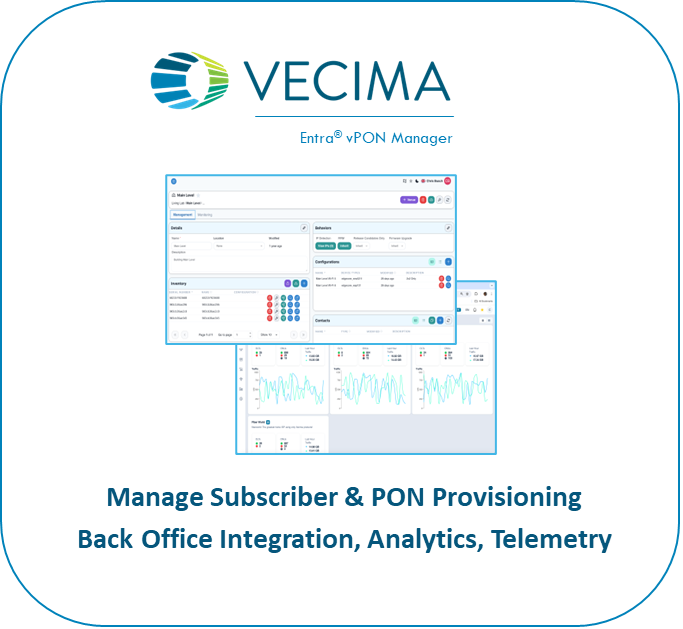
Vecima’s vPON Manager was developed in close collaboration with BSPs to address these challenges. It provides the provisioning, configuration, fault management, and analytics that form the cornerstone of modern ITU PON access networks, within a unified, cloud-native management environment.
How It Works
Entra vPON Manager delivers software-defined control for XGS-PON deployments, giving operators a streamlined way to provision services, integrate back-office systems, and monitor network health. Its microservices-based architecture offers flexibility for deployment on-premises or in the public cloud, ensuring scalability across distributed networks.
All system features are accessible via industry-standard REST APIs, making it possible for BSPs to integrate seamlessly with existing operational and telemetry systems. Support for Kafka-based streaming telemetry gives operators deep network visibility and real-time insights.
PON Service Groups & Zero-Touch Onboarding
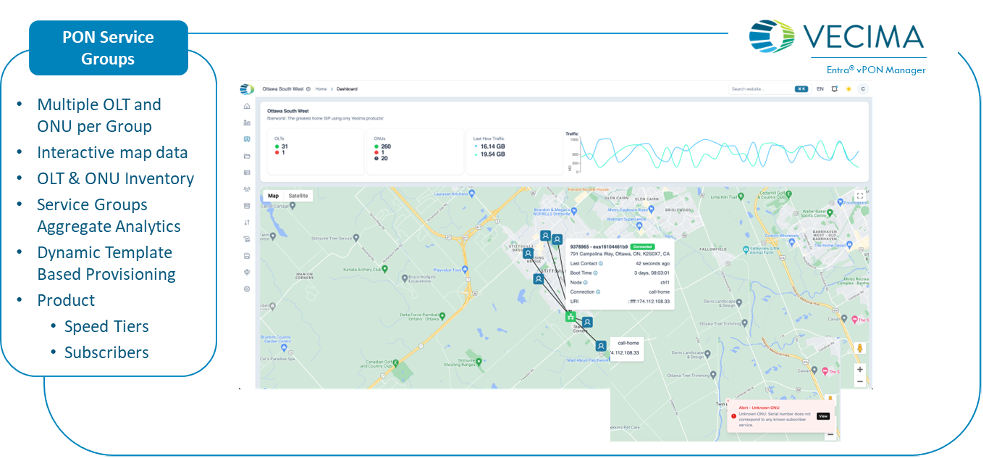
To simplify the deployment process, Vecima introduced the concept of PON service groups — a model inspired by traditional cable network frameworks like Cable Service Groups and MAC Domains. This approach enables BSPs to organize and manage PON assets by geographic area or market, aligning operational models across legacy and fiber networks.
Coupled with Zero-Touch OLT controller discovery and automated subscriber onboarding, the result is a deployment process that’s fast, consistent, and highly scalable.
With vPON Manager’s dynamic subscriber device provisioning, service setup can be completed in just four steps:
Once linked, the ONU connects to the PON access network, provisioning completes automatically, and the subscriber is live with symmetrical gigabit — or even multi-gigabit — service.
Key Benefits for Broadband Service Providers
The vPON manager helps BSPs reduce the complexity of XGS-PON deployment and management. Key benefits include:
The Future of XGS-PON Management Starts Here
As fiber networks evolve to meet changing bandwidth needs, XGS-PON has become a key enabler of next-generation broadband. But realizing its full potential requires the right deployment and management framework. One that brings automation, flexibility, and visibility together in a single platform.
Vecima’s Entra vPON Manager delivers exactly that, empowering BSPs to deploy, monitor, and scale XGS-PON services with confidence. To learn more about how vPON Manager simplifies fiber network operations, visit our vPON Manager product page or contact Vecima to connect with an expert.
Back to all resources
We help our customers evolve their networks with cloud-based solutions that deliver ground-breaking speed, superior video quality, and exciting new services to their subscribers.
Contact Us