


Building a Digital Twin to Speed Up R-PHY Testing in DAA Networks
By: Colin Howlett, Chief Technology Officer
February 18, 2026
In a modern Distributed Access Architecture (DAA) rollout, Remote PHY (R-PHY) integration testing has quietly become one of the biggest factors in deployment velocity. This is not because the technology doesn’t work, but as the number of network devices, Remote PHY Devices (RPDs), and cable modems increase, the interactions between systems begin to exhibit timing, performance, and interoperability behaviors that are impossible to observe at small scale.

Most failures don’t come from a single broken component, they show up when otherwise compliant systems meet real traffic, real timing pressure, and real scale.
A new build of a virtual cable modem termination system (CMTS) might introduce subtle scheduling changes that look harmless in isolation but behave very differently under sustained load. An RPD from one vendor may negotiate timing or synchronization slightly differently than another, both compliant, both correct, yet not perfectly aligned. Even routine software updates that pass unit testing can surface edge conditions only when thousands of modems and multiple RPDs are in play.
That’s why R-PHY testing has evolved. In today’s environment, the goal is to understand system behavior while also validating features and understanding how all moving parts behave together under realistic operating conditions.
Why R-PHY Testing at Scale Matters Now
Access networks are more complex than ever, and that complexity isn’t accidental. It’s the natural result of several structural shifts happening at the same time:
Modern R-PHY testing has to address all of this simultaneously. Scale, automation, interoperability, and change velocity are now table stakes. That means validation environments must support:
With all these variables, it’s no surprise that operators are moving toward R-PHY test platforms and simulators designed to mirror real network behavior instead of approximations.
Why Lab-Scale R-PHY Testing No Longer Works
Traditional DOCSIS labs were built for a very different world. A handful of modems, a small number of RPDs, and manual test cycles were once enough to validate changes with reasonable confidence.
That model breaks down in today’s access networks.
Modern DAA environments are software-driven, continuously updated, and stitched together from both physical and virtual components sourced across vendors. At this point, scale itself is a variable. Some failure modes simply don’t exist until compliant systems interact under sustained, production-like load.
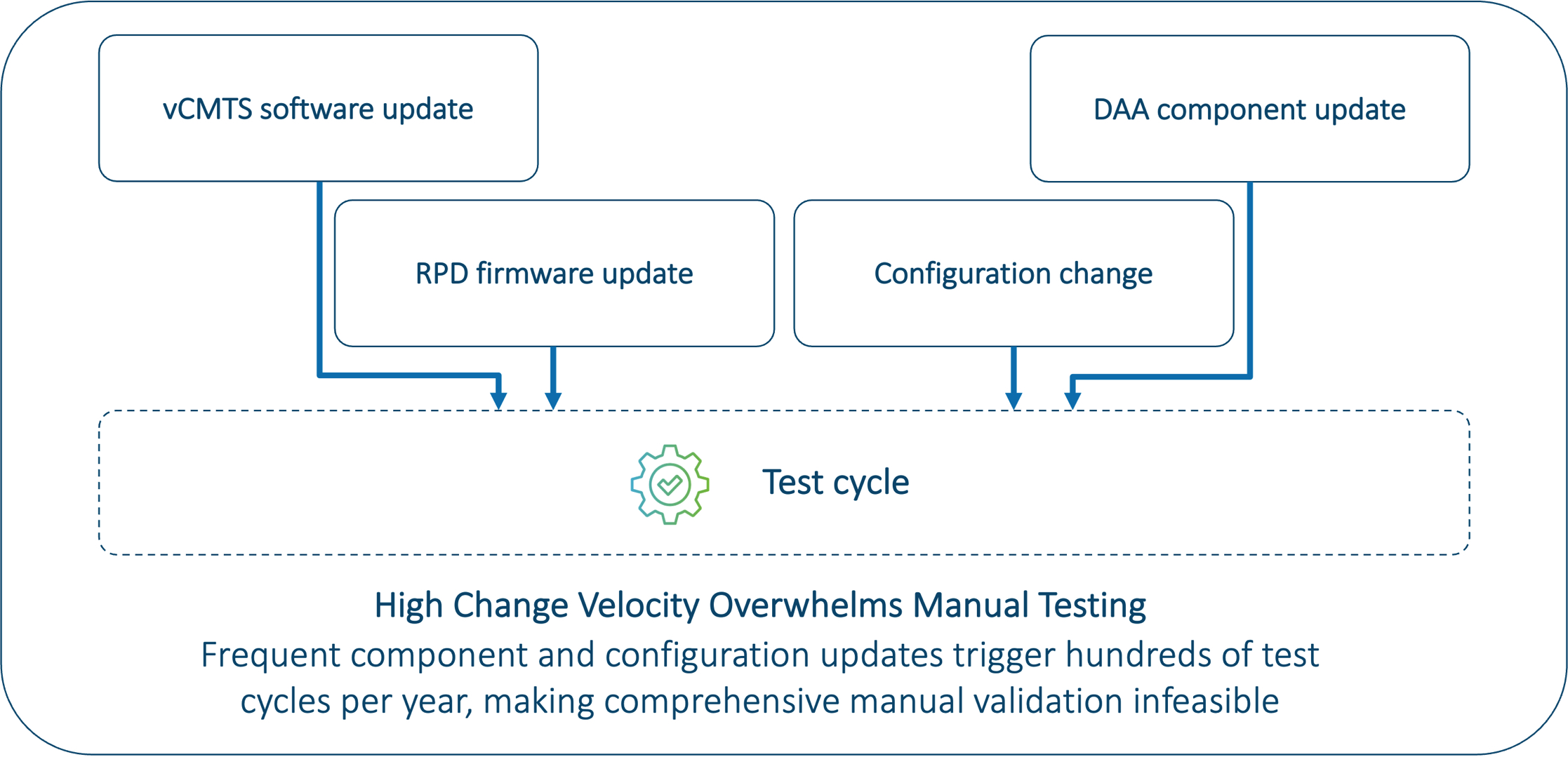
Engineers need production-realistic testing that allows for validation before changes hit live networks, not another tightly controlled lab scenario.
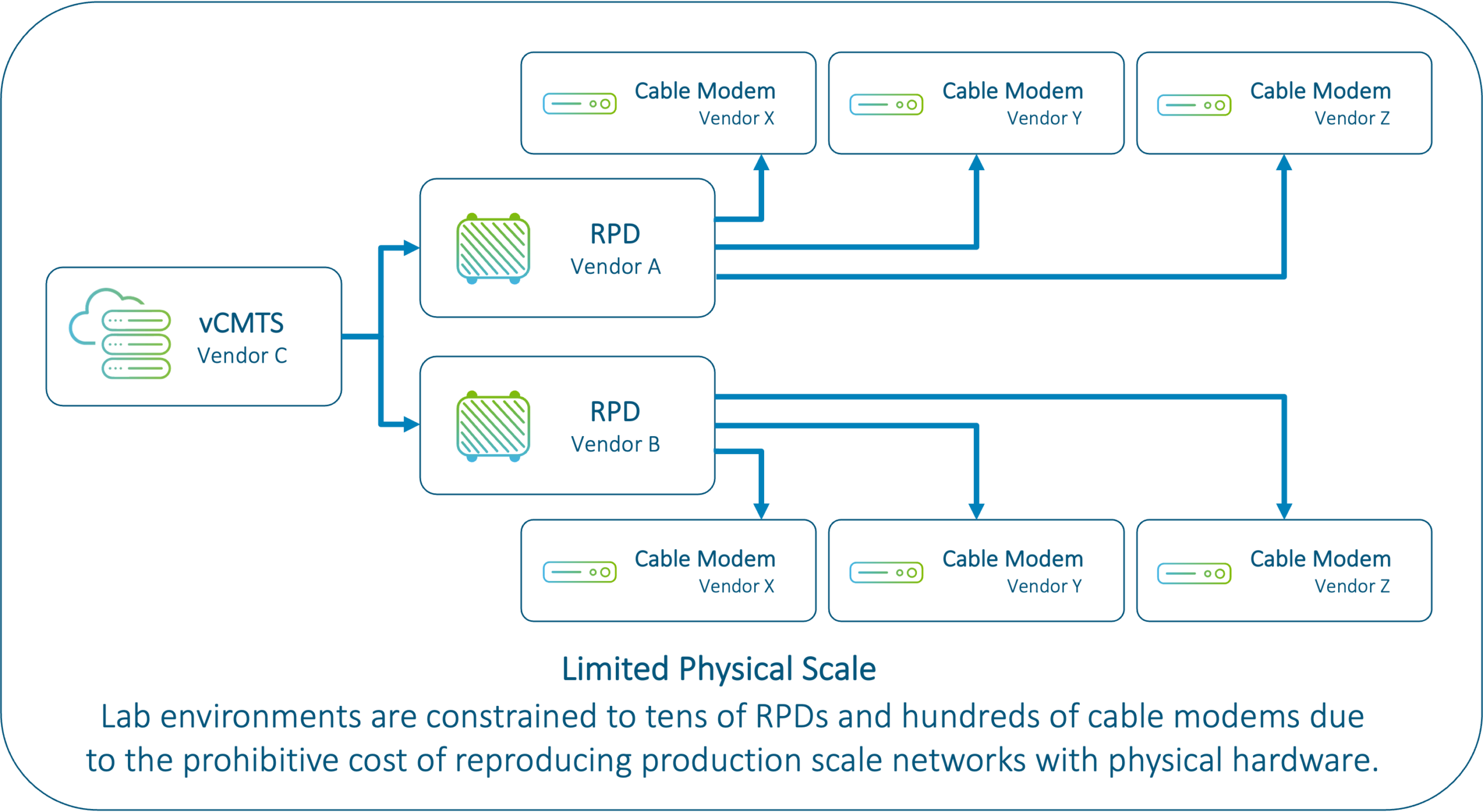
The goal to confirm quality, reliability, and standards compliance hasn’t changed. But the way that confirmation happens has. It needs to take place earlier, continuously, and with high fidelity to real-world behavior.
Meeting these goals requires a platform that orchestrates and automates validation, along with a system capable of reproducing production-scale network behavior without relying on large physical test deployments. That is why access test platforms and access simulators are critical.
Cutting DAA Deployment Time Through Digital Twin R-PHY Validation
One of the most effective ways broadband service operators (BSPs) are accelerating DAA deployment is by decoupling validation from physical scale. Instead of waiting for large lab builds or extended field trials, teams validate behavior continuously using production–realistic test environments.
The Entra Access Test Platform and Entra Access Simulators support this approach by enabling:
The practical impact is simple: Testing cadence finally matches software cadence.
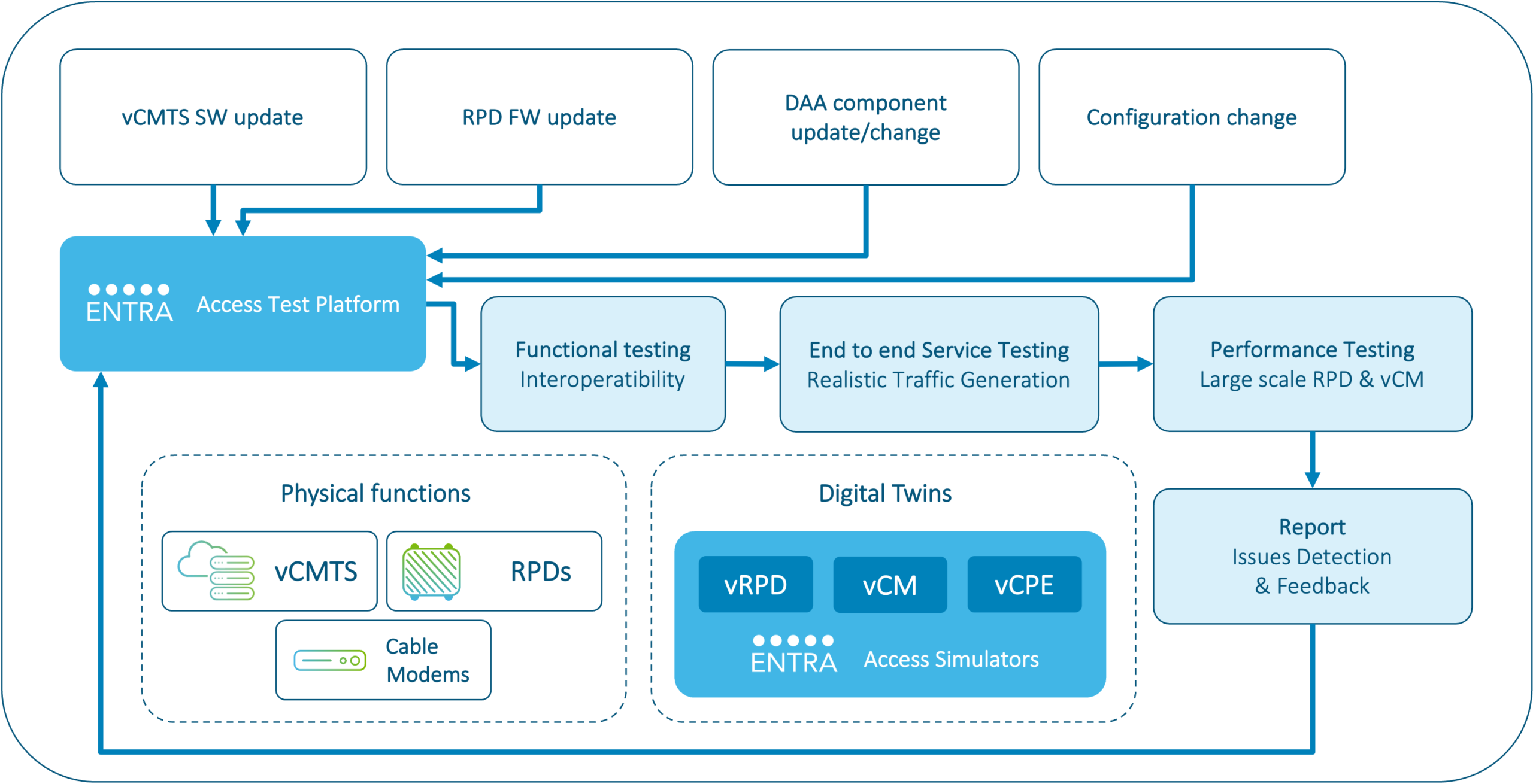
Operationally, this means:
Instead of testing that lags behind the network, the test environment evolves alongside it.
Interoperability Is Where Deployment Time Is Won or Lost
1. Why Standards Compliance Alone Is Not Enough
Some of the most painful interoperability issues arise from differences in interpretation, not when things are “broken.” In fact, everything often works exactly as designed. The problem is that different vendors can read the same specification and make slightly different choices.
Those small differences add up. One system handles timing a bit differently. Another negotiates synchronization in its own way. Buffering and scheduling decisions follow the spec, but not always the same logic. On paper, everything is compliant. At scale, behavior starts to diverge.
That’s when problems show up. Performance slowly degrades. The system becomes unstable under load. Issues appear and disappear, making them almost impossible to reproduce in a traditional lab.
As access networks become more distributed and software driven, this kind of behavior matters significantly. Components that look perfectly stable on their own can behave very differently once they are part of a full, production-scale network. And those differences only become visible when the system is tested the way it will actually be used.
2. Validating vCMTS and RPD Behavior Across Vendors
The Entra Access Test Platform and Entra Access Simulators are designed to validate interoperability across major vCMTS vendors, while supporting RPDs compliant with the CableLabs® R-PHY specification.
This allows engineers to move beyond basic questions like “does it work?” to more specific queries like “how does it behave with everything else?”
By recreating production-scale traffic patterns and access behavior, teams can observe interactions that would otherwise remain hidden until deployment — timing alignment, control-plane behavior, and performance under sustained load.
Catching these issues before they reach the live network reduces risk and shortens rollout timelines.
3. Turning R-PHY Interoperability Testing into a Repeatable Process
Interoperability testing is most effective when it is repeatable and continuous rather than ad hoc. In this context, R-PHY testing focuses on long duration stability, performance consistency across vendors, and ongoing standards compliance as software versions evolve. When new vendors or releases are introduced, they can be evaluated through a structured validation process that produces consistent and comparable results.
For engineers, this approach reduces uncertainty as configurations move closer to production. Instead of discovering interoperability issues late in the deployment cycle, problems are identified earlier, when they are easier to analyze and resolve. Over time, this leads to fewer surprises, faster deployments, and a more predictable path from validation to production.
What Industry Adoption Reveals
This approach is increasingly visible among large operators. Liberty Global has publicly described using Vecima Entra Automation Solutions as part of its effort to simplify and standardize network operations across regions and access technologies.
What stands out is the mindset instead of a single feature.
Testing is treated as an automated, repeatable engineering function, not a one-time lab exercise. The lab effectively becomes a digital twin of the access network, enabling engineers to observe production-scale behavior before changes reach customers.
In this model, R-PHY testing becomes part of everyday change management. Workflows are fast, automated, and repeatable, freeing engineers to focus on analysis and optimization instead of rebuilding the same lab scenarios over and over again.
Take the Next Step: Validate Faster Before You Deploy
If your DAA rollout timelines are constrained by testing rather than architecture, it’s time to validate access changes earlier and at a realistic scale.
The Entra Access Test Platform and Entra Access Simulators enable BSPs to test vCMTS and RPD behavior across vendors, under production-like load, before changes ever touch the live network.
And if your goal is to shorten rollout cycles, reduce deployment risk, and shift engineering effort from repetitive lab setup to meaningful analysis, get in touch with our team — we’d be happy to talk about how Entra Automation Solutions fit into your existing R-PHY and DAA workflows.
Back to all resourcesWe help our customers evolve their networks with cloud-based solutions that deliver ground-breaking speed, superior video quality, and exciting new services to their subscribers.
Contact Us