


How Generative AI is Transforming Live Sports Streaming Optimization
By: Nick Dunkin, Senior Director Product and Innovation
March 12, 2026
 Live sports streaming can push every element in your video delivery chain to its limit, exposing every potential weakness in seconds. When the Super Bowl, the Olympics, or a World Cup match goes live, traffic ramps fast, margins for error disappear quickly, and quality issues that were masked during testing become obvious once millions of viewers arrive at the same time, across devices and networks that behave nothing alike.
For content providers and streaming platforms, the challenge is familiar. Contribution paths are complex; source quality varies even within a single production, and yet everything downstream is expected to look consistent and broadcast-grade. Video optimization has long absorbed that pressure through careful encoding and bitrate discipline, but as resolutions rise and delivery costs stay under scrutiny, those techniques are being pushed to their limits.
What Is Video Optimization in Live Sports Streaming?
In live sports, video optimization is not a feature so much as a constant negotiation between competing constraints. Bitrate, latency, quality, and scale are all in play at once, and pushing one almost always means giving ground on another.
Most live workflows rely on carefully constructed bitrate ladders, ranging from mobile streams to UHD profiles that can exceed 15 Mbps. The goal is less about hitting a perfect resolution than about maintaining perceived quality, which is why metrics like VMAF (Video Multimethod Assessment Fusion) have become practical tools rather than academic ones. A stream that technically resolves 4K but collapses under motion is rarely perceived as high quality.
Sports content makes this balancing act harder. Motion is constant and often chaotic. Textures such as grass, ice, and crowds are quick to break down under compression. Camera cuts are frequent and unpredictable. Even within a single event, source feeds can range from pristine, fiber-fed cameras to signals arriving compressed or constrained by wireless contribution links. Optimization, in this context, is about managing inconsistency as much as maximizing quality.
Why Traditional Optimization Techniques Are Reaching Their Limits
Most live sports workflows already rely on a familiar mix of codec tuning, content-aware encoding, and increasingly complex bitrate ladders. Those tools still matter, but they are being pushed to their limits as resolutions rise, and delivery budgets tighten, particularly during peak events where there is little room for error.
The strain tends to show up in predictable ways:
At that point, optimization becomes less about refinement and more about managing compromises, which is why many teams are looking beyond incremental codec gains for their next step.
What Makes Generative AI Different for Live Sports Video
Generative AI shifts the optimization problem by addressing what compression removes rather than how it removes it. Instead of preserving pixels as efficiently as possible, generative models learn the structure of high-quality video and use that understanding to reconstruct detail lost along the way.
In practice, this results in cleaner motion, reduced noise, and better preservation of fine detail under compression. Textures that typically collapse first tend to hold together longer. Upscaling from 1080p to 4K becomes less about stretching frames and more about restoring structure.
This approach aligns particularly well with sports, where motion is fast, textures are complex, and source quality is often uneven. The goal is to enhance the details that are often lost, and to narrow the gap between feeds that arrive in very different conditions.
How KeyFrame Generative AI Redefines Sports Streaming Optimization
Live sports workflows rarely fail because teams don’t know how to encode. They fail because the sources aren’t consistent, and because the sources can’t always be made consistent in real time without blowing up bitrate, cost, or operational complexity. A production can have “hero” feeds and messy feeds in the same show, and viewers don’t grade them separately; they just decide the stream looks good, or it doesn’t.
dh/KeyFrame is built for that reality, and immediately compatible with your existing workflows: it’s a bump-in-the-wire component that sits upstream of the transcoder. You don’t have to replace your codec strategy, redesign your delivery chain, or rework how you capture or originate video. Drop KeyFrame into the path, feed it the sources you already have, and it focuses on its narrow, valuable job: improving perceived quality, while allowing you to hold bitrates flat or even reduce them. That’s the real economic lever. Bitrate is cost.
Seamless Integration
Zero impact to existing encoding pipelines with “bump in the wire” workflow solution, operating on the server-side, pre-encoder – whether that’s on-prem or in the cloud.
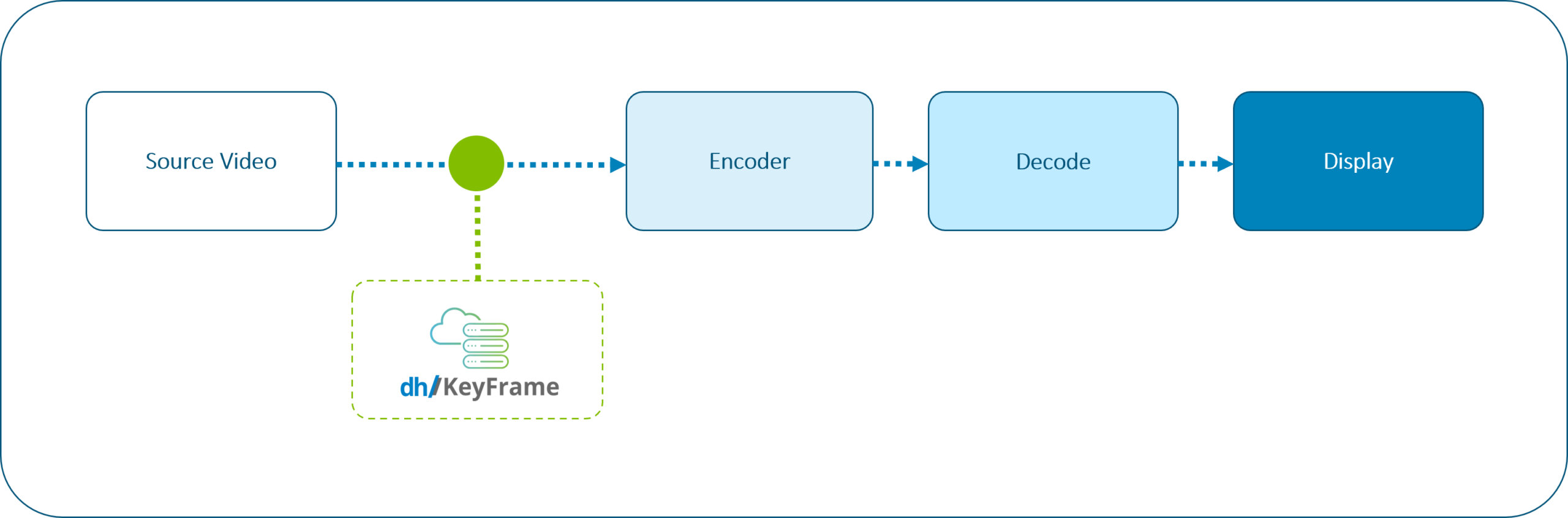
Where KeyFrame delivers in real deployments is in the places content providers feel pain today: not in headline-grabbing “AI Revolution” narratives, but in improving the perceived quality of weaker feeds and keeping quality consistent across all feeds when motion and texture would normally fall apart.
What KeyFrame changes:
That’s the beauty of it. No re-architecture. No “replace everything” mentality. Just a practical way to make live sports look better, more consistently, under the same constraints you’re already operating within.
Preparing for the Future of Live Sports Streaming
Live sports will only get harder to deliver. Higher resolutions, more devices, more feeds, and rising expectations are colliding with ongoing pressure to control cost and complexity. Solutions that last will be the ones that improve quality and efficiency and leverage existing infrastructure and investment, without forcing teams to rethink workflows that already work.
That’s why Generative AI-based video optimization is starting to look less experimental and more foundational, particularly when it can be deployed selectively, securely and integrated easily into existing pipelines.
See KeyFrame in Action
Live sports don’t leave much room for theory. If a solution can’t improve quality and efficiency without disrupting existing workflows, it’s hard to justify deploying it at scale. KeyFrame is built for exactly that reality: a real-time, bump-in-the-wire approach to generative AI video optimization that delivers better-looking live sports streams at the same or lower bitrates.
If you want to see how KeyFrame performs on real sports content, contact our team to watch a short demo and discuss your live workflow.
See KeyFrame Live at NAB Show 2026
If you are attending NAB Show 2026, visit the Vecima booth to see KeyFrame Generative AI video optimization running on real sports content.
📍 Booth number: W2300M
📅 Dates: April 19–22, 2026

Back to all resources
We help our customers evolve their networks with cloud-based solutions that deliver ground-breaking speed, superior video quality, and exciting new services to their subscribers.
Contact Us